
Neil F. Payne
1939 –
Inducted 2026
How much biodiversity will humans damage or destroy before they, like other animals, feel the consequences profoundly? A healthy ecosystem is the foundation of a healthy society.
-Neil F. Payne
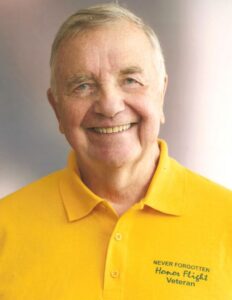
Neil F. Payne’s life and career reflect a deep commitment to wildlife conservation and education, and to Wisconsin, where his ancestors were the first to settle in the town of Mitchell in Sheboygan County, Wisconsin.
In 1939, Neil was born into a blue-collar family in Plymouth, Wisconsin; he was a sixth-generation Wisconsinite. His dad didn’t graduate from high school, and both parents, Forrest and Ruth, worked in a factory making toilet seats. For a while they lived in a rented house without running water. Neil’s first memory was at age three, in the back hall of the house, and being scared stiff of a mouse (he who would, as an adult, live-trap bear!). Neil was raised in Sheboygan Falls, with a younger brother, Glenn, and a sister, Virginia, and developed an early interest in nature and animals on his grandfather’s farm.
Neil graduated from Sheboygan Falls High School in 1957. He became the first person in the family’s ancestral line to graduate from college, earning a BA in zoology in 1961 from the University of Wisconsin (captain of UW fencing team, Big Ten Champions). He went on to obtain an MS in wildlife science from Virginia Tech in 1964 (a thesis on rabbits that entailed pulling and tagging 516 rabbits barehanded 857 times from wooden live-traps), and a Ph.D in wildlife science from Utah State University in 1975 (dissertation on beaver).
He became a “Wildlifer,” not fully aware that he was stepping into a most complex and essential profession—maintenance of the biodiversity of ecosystems required by all life. As a Wildlifer, he became a manager, researcher, professor, and author.
Neil married Eileen Tagge in 1964 and then served as a captain in the U.S. Marine Corps as a combat engineer during the Vietnam War (1964-67), living in Virginia, North Carolina, Puerto Rico, California, the Philippines, Okinawa, and Vietnam. His first employment after leaving the Marines was as a bear and furbearer biologist in the Canadian province of Newfoundland and Labrador (1967-71) where he extended the beaver trapline management system throughout Newfoundland, designed the province’s caribou arm patch, and solidified his field credentials as a wildlife researcher by initiating research on black bears, martin, otter, beaver, and red squirrels. He also worked at the University of Washington in Seattle (1973-75) for Dr. Richard D. Taber, Aldo Leopold’s last surviving graduate student, with whom Neil co-authored the book, Wildlife, Conservation, and Human Welfare.
After a 14-year round-trip involving the Marine Corps, the Vietnam War, wildlife pursuits, and four single and seven family moves (not counting USMC moves) across the United States and Canada, Neil returned to Wisconsin in 1975 from Washington State, driving a large U-Haul, his two boys beside him, with a loaded station wagon attached (dog and cat inside, canoe on top). He spent most of his career as a professor of wildlife ecology at the University of Wisconsin-Stevens Point (1975-1998), teaching for 23 years, conducting wildlife research with his graduate students, and publishing.
Neil’s numerous contributions to wildlife conservation encompass education, research, and literature. Using his experience as a wildlife biologist, he taught wildlife ecology to more than 4,600 students, with about 50% of WDNR wildlife biologists being UW-Stevens Point graduates. He conducted research on more than 20 wildlife species and published extensively, including seven books on wildlife management.
His work has influenced conservation practices in Wisconsin and beyond, with a focus on habitat management. Neil’s efforts have had a lasting impact on wildlife conservation and education. His students have gone on to significant careers in conservation, influencing policies and practices in Wisconsin. Neil’s books and teachings are widely used in wildlife management and conservation education.
Support letters from colleagues and family emphasize Neil’s influence and contributions. Scott Craven, a professor emeritus and WCHF inductee, praises Neil’s extensive impact on students and wildlife conservation. Adam Payne, Neil’s son and former Secretary of the Wisconsin DNR, reflected on his father’s teachings and their influence on his own conservation work:
Our dad is a dedicated conservationist who had an extraordinary career. His broad experience, talent, and determination, combined with a good sense of humor, made him a very effective teacher, mentor, and leader who positively motivated and impacted others.
Dr. Payne has made significant contributions to wildlife management and education in Wisconsin over a distinguished 57-year career. He authored more books on wildlife management than any other author. He continued writing even after retirement, providing valuable resources for students and professionals. His influence extends to many students who are now engaged in impactful conservation work.
Personal accounts from colleagues and students emphasize Dr. Payne’s engaging teaching style and mentorship. Jeff Shaw, a DNR retiree whose father, WCHF enrollee Byron Shaw, Neil’s deceased close friend and hunting and fishing partner, recalled learning and collaborating with Neil since 1975 and appreciating his humor and wisdom in wildlife biology. Neil’s teaching methods and humor captivated students and made learning enjoyable. Many students attribute their pursuit of wildlife-related careers to Neil’s motivation and guidance.
Dr. Payne’s extensive education and diverse professional experiences have shaped his expertise in wildlife ecology. His publications have played a crucial role in advancing wildlife management practices and education. He authored several key textbooks and guides on wildlife management, addressing integrated ecosystem management. His works serve as technical guidance for wildlife professionals, students, and landowners. His latest book, Wildlifer, is extraordinary and a career highlight. It is an unprecedented chronicle of Wisconsin’s wildlife management history and reflects his commitment to education well after his retirement.
Dr. Payne is recognized as a Certified Wildlife Biologist and received Outstanding Scholar Awards from UW-Stevens Point. His book on wildlife habitat management won the UW-Stevens Point Publication Award and the Annual Publication Award from the Texas Chapter of The Wildlife Society. He is listed in various professional directories and recognized for his many contributions to conservation.
He and Eileen Tagge had three children before divorcing in 1984: Adam, born on the Pacific coast in California, while Neil was in the Marines in Vietnam. Mark, born on the Atlantic coast in Newfoundland, and Erin, born on the Pacific coast in Washington State. It’s an indication of how much they moved in a relatively short time, and the difficult, stressful decisions and actions involved. Neil married Jan Lyman in 1986, and has three step-children–Patty, Shari, Gail–grandchildren, and great-grandchildren.
After he retired in 1998, he wrote several more wildlife books. He and Jan spend their retirement during the summer in Wisconsin and in Newfoundland and Labrador, where they were during 9/11 in 2001, helping to buy and distribute food to the foreign “plane people” forced to land there. They winter in Florida, where he sings bass in a mixed chorus directed by Jan. At 86, Neil continues to enjoy the outdoors, birding, plant walks, and recently went on a successful moose hunt in Newfoundland with his two sons.
RESOURCES: